
The Rational Desire of Criticism
Ten Theses

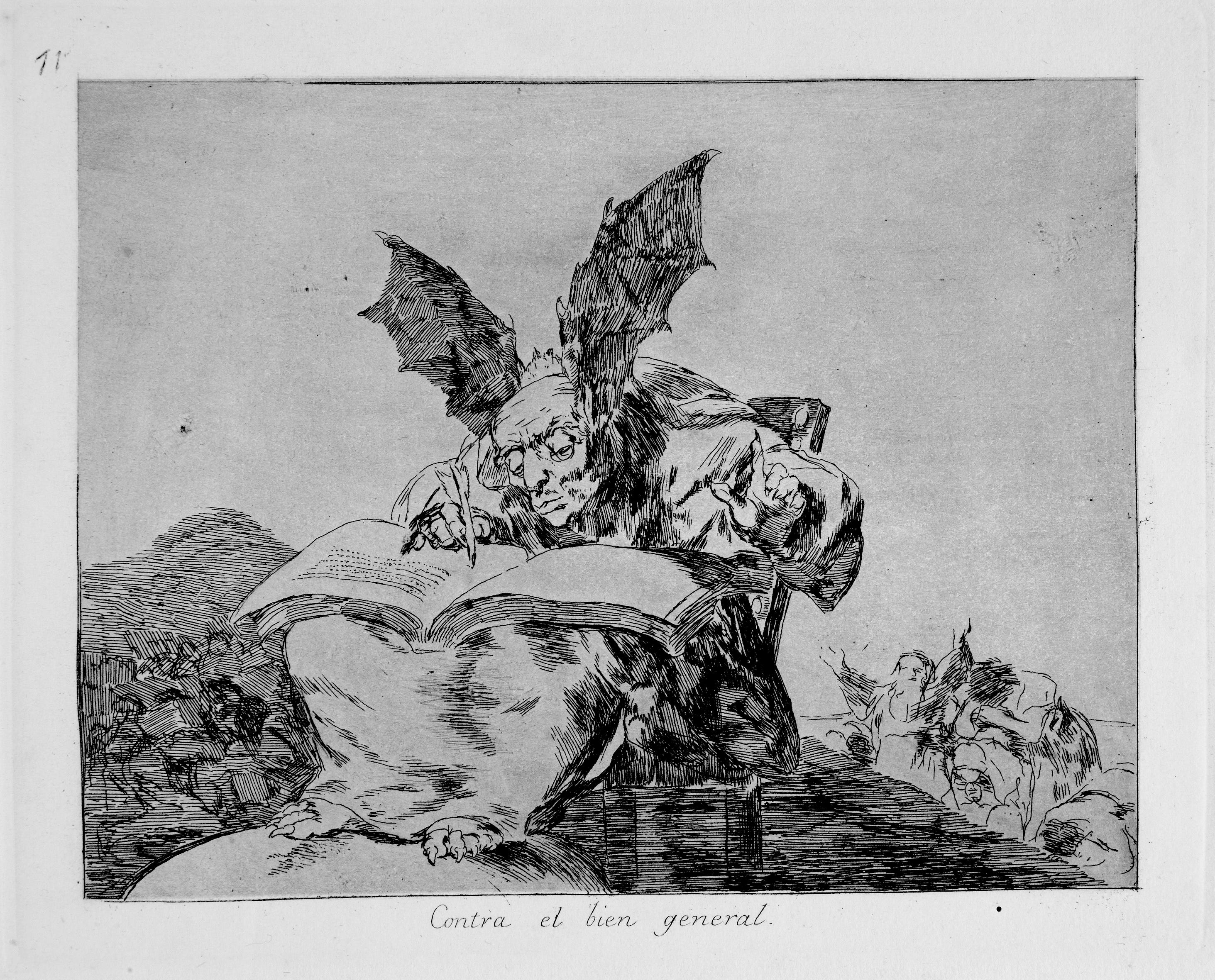
Francisco de Goya, Disasters of War, no. 71 (1814-15).
1. The desire of criticism is that its object is rational; that this object has its own rationality. As Northrop Frye observes, “criticism cannot be a systematic study unless there is a quality in literature which enables it to be so,” which is to say that “just as there is an order of nature behind the natural sciences, so literature is not a piled aggregate of ‘works,’ but an order of words” (Anatomy of Criticism, p. 17). In this search for order, criticism gambles that its object will meet it partway, having already completed the work of assembling a rational order for itself. Frye’s phrasing is auspicious: criticism must consider itself a science, inasmuch as its object is suitable for a systematic exposition. In the absence of this ambition, the work of the critic must be unsystematic by nature, rendering them a ‘man of letters’ whose forays into literature may be tasteful or edifying though little more than that.
2. Somewhere between the systematic criticism of Frye’s ‘literary scientist’ and the unsystematic art of the belletrist subsists the partial criticism of explanation. This is the criticism that explains the work by external terms, not trusting the work to sustain its own rational order. This practice hangs on the strength of analogy: one work is related to another by the will of the critic, justified more or less by some resemblance between the two. In this manner, the first work is made rational by the power of the second, i.e. “The mystery of this work may be solved by consulting the history books…” or “This or that element recalls something a philosopher once said…” By the popularity of this mode, the work of the critic so often appears as a redoubling—producing books about books. Still, if the analogy holds, it must be not only by the will of the critic. Rather, the fact that one work explains another betokens a relation that inheres within them both, though the indelicate critic sees in this coordination a subordination of one work to another.
3. One can always ask: If this explanation applies, what do I gain by reading the critic and not the work alone? The desire remains for the resemblance between works to speak on its own, for the critic to only register what is already there in the works themselves. However, it is here that criticism may be interrupted by a second order of explanation, which, having discovered a rational connection between works, seeks to apply this particular connection universally. A much-criticised example of this faith in explanatory concepts is the naive Freudianism which always looks for, always finds, the same explanations in the unconscious, neurosis, cathexis, etc. “Of course, there are Oedipal statements. For example, Kafka’s story, ‘Jackals and Arabs,’ is easy to read in that way: you can always do it, you can’t lose, it works every time, even if you understand nothing” (Deleuze & Guattari, A Thousand Plateaus, p. 37). This is not uncommon when philosophers attempt criticism: the concepts of ‘law’ and ‘life’ are notable, to be sure, but to cast Kafka The Trial as ‘about’ law or Mann’s Magic Mountain as ‘about’ life is to render any subsequent analysis of these works superfluous. At its most extreme, the ambition to supplant the work with a unitary concept is the market-function of criticism: to ‘review,’ to summarise, to produce content from what the work is ‘about,’ is to aid consumption by rendering the work a pithy item for the market.
4. The attempt to fix a unitary concept for the work is to mistake the nature of concepts, which are not themselves unitary or isolated but inhere within a symbolic field which structures their meaning. The critic who attends to the symbolic organisation of a work may show that it is systematically and rationally composed, without thereby claiming to settle the matter of its interpretation once and for all. Rather, this critic works through the work in another register, revealing the paths by which it may be traversed, each of which is equally rational, though none exhaust the critical endeavour or the work itself. To make this abstract discussion concrete, we may take Jacqueline Rose’s reading of Christina Rossetti for an example (published initially in LRB, and more substantially in On Not Being Able to Sleep). Though Rose writes of certain enigmas and even puzzles in Rossetti’s poetry, which seem to orbit some unspoken centre of fixation, she treats these as occasions for analysis rather than solution. Rossetti’s work might be explained with reference to a religious concept of sin, a psychoanalytic concept of incest, or a psychobiographical concept of sibling rivalry, but none of these terms quite puts an end to what puzzles us about her works. To be clear, this inexhaustible puzzling is not due to some fullness on the part of the text, the boundless creativity of art, or any other Romantic cliche. Instead, it is the incompleteness of any expression, any explanation, or let us say any attempt to map the symbolic field, which keeps the poem’s secrets. There is no secret that can put an end to criticism, though the critic can arrive at a more or less satisfactory account in the register of their choice. Let this be a lesson from psychoanalysis: Nobody will tell you who you ‘really are;’ actuality cannot be reduced to a stable essence.
5. From this rationalisation of a singular work ensues a greater desire: that not only the work of literature is rational but so is the body of literature itself. If we can correctly place the work, we can discover a coherence which it cannot speak alone. This is the ambition of Virginia Woolf’s ‘rediscovery’ of women’s literature in A Room of One’s Own, or on a smaller scale in T.S. Eliot’s vindication of the metaphysical poets. We may recognise in these works what was not legible at another time; that they belong to a ‘tradition,’ which is the old-fashioned way of saying a rational discourse or sequence of discourses. The writings of an Aphra Behn, a Margaret Cavendish, or a Charlotte Smith, which were apparently drowned out by the masculine discourses of their centuries, are recognised at a later date as foundational contributions to a significant body of women’s literature. Likewise, the metaphysicals are not only ‘lesser Elizabethans’ or ‘Shakespeare’s contemporaries’ (defined and denigrated by these analogies) but belong to their own school with their own organic unity and development.
6. That the body of literature is constructed retroactively is no recent observation. Its most notable formulation is found in Borges’s essay on “Kafka and His Precursors,” though retroaction as the general law of reason is also to be found in the ‘objective spirit’ of Hegel’s Phenomenology, if not ultimately in the Abrahamic fulfilment of figural types in their antitypes. Within the boundaries of literary reason, it must be understood that traditions are not hewn in stone but are a processes of rationalisation, as each subsequent work adds to its precursors, and, participating in their concept, brings them to new light.
7. Still, let us be mindful of our metaphors: To bring something to light is an edifying and familiar image, but not always the most apt for reason’s labours in negativity. The work of the critic may just as well be likened to Walter Benjamin’s image of Messianic destruction, which blasts “a specific life out of the era, a specific work out of the lifework” (“Theses on the Concept of History,” XVII). Retroactive reason does not only compose bodies of sense; it wrenches pieces from the background of history, from other bodies, living or dead, so that these may be assigned new meanings. This destructive tendency in criticism may be contrasted with that which produces allegorical readings. Allegorical interpretation seeks to register the multivalence of the work in the coextension of literal, symbolic, moral, and anagogical meanings; but when put to page, criticism loses the ambivalence of the work. Though the work contains multitudes, the critic tends to bring this or that order to focus, more or less obscuring the others.
8. Hence the pugnacity of bad critics, who must fend off competing explanations in mutual distinction from their own. Allegorical readings are ecumenical in their recognition of multiple sources of textual meaning, and so require a humility toward the open text. By insisting upon one order of meaning over another, the critic collapses the multivalence of the text into a basic symbolism, wherein one element only ever corresponds to one valid meaning. In this manner, the text is closed off, and the task of the critic turns from demonstrating its openness to enforcing its closure, tending away from criticism proper toward mere polemic. Such criticism resembles the polemics of a theologian who, having proved the existence of a god by arguments ontological and cosmological, must prove the providence of this god by eliminating as nonsense all other deities. The zealot, literary or otherwise, implicitly places themselves above the object of their piety, as its protector, keeper, and master.
9. Better, we should say the critic adds to the body of literature and does not stand outside it. The critic’s ambition is not only to discover the rationality of a work, but to demonstrate that this reason and their own are one and the same. In the process of rationalisation we hope to be met halfway, as the work demonstrates its own rational character, being not a product of chance but a sherd of past thought, awaiting revival in the present. As a contribution to this hidden order of written words, the work of the critic must itself be a species of literary pursuit; or, we can say that criticism is the genre of literature’s self-consciousness, which turns back on itself to reexamine the works once thought finished.
10. The rational desire of criticism, no different from the desire of all reason, is to close the circle upon itself. To sift through volumes, to pore over the scratchings of some old Dryasdust, to grey in silent company, is to hope for evidence of an intelligible order to the human world; that the critic who can sift the ideal from the fragments of time is safe in the knowledge that their reason blessedly predates them.