
The True is the Whole
Hegel's Preface to the Phenomenology, V (§20-24)

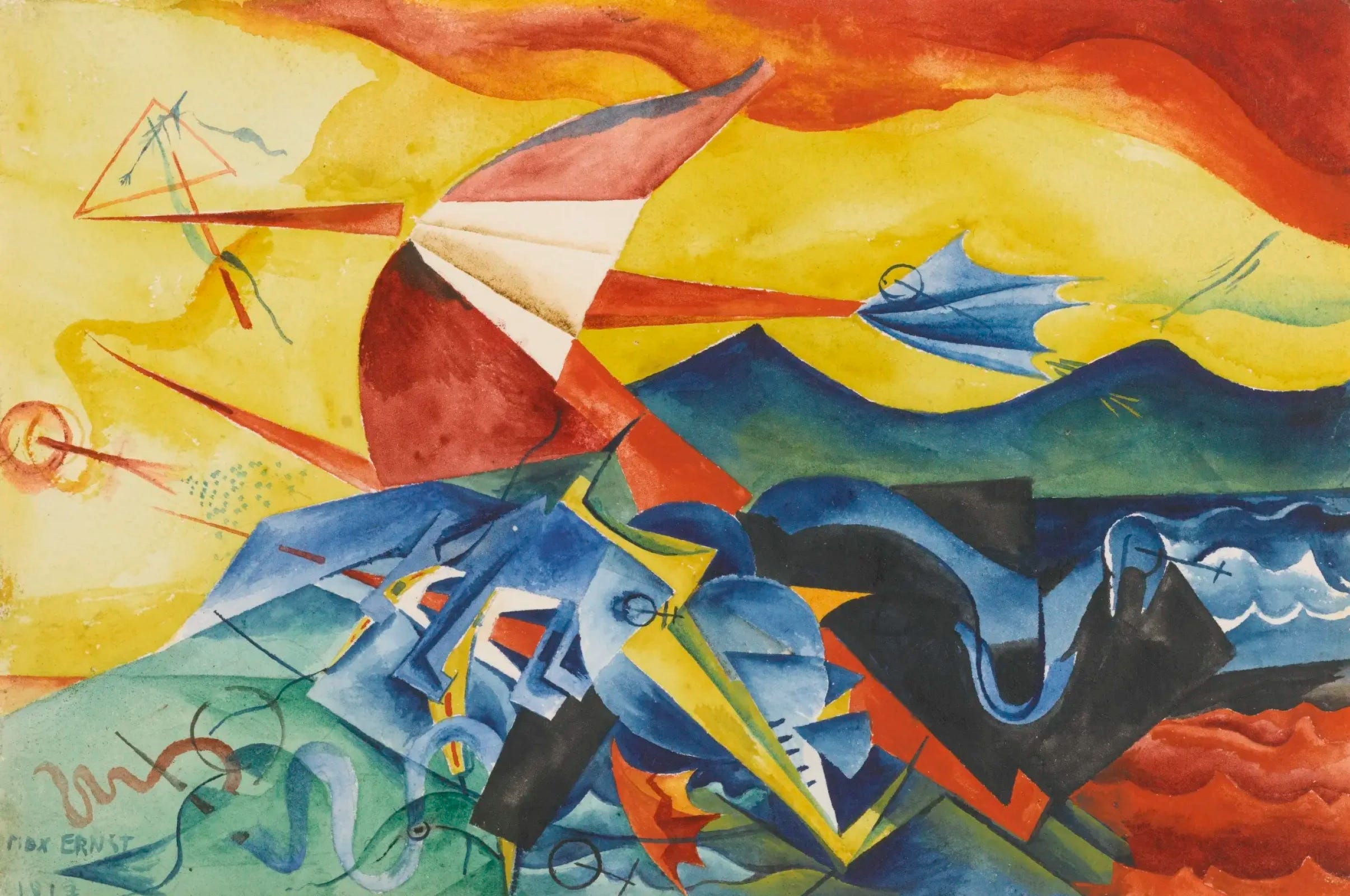
Max Ernst, Composition (1917).
This article is part of a monthly series on the Preface to Hegel’s Phenomenology of Spirit, adapted from my lectures on the topic for the Melbourne School of Continental Philosophy in 2024. Quotations from the Phenomenology are cited by paragraph number, from Michael Inwood’s translation (Oxford University Press, 2018). Each article is written to stand intelligibly on its own. A contents page for the series can be found here.
Thus far in the Phenomenology, Hegel has made his preliminary diagnosis of Western metaphysics as an alternation between first principles. Hitherto, the history of philosophy has been the history of warring metaphysics, between the camps of subject and substance as concepts of the absolute. One side, including such epochal thinkers as Descartes and Kant, insists upon the priority of subjectivity in the logical structure of the universe, while the outlaws of philosophy, Spinoza and Schelling, assert a universal substance as the basis of this very subjectivity. In either case, the first principles of subject and substance are given an absolute place within the system of thought, as the terms from which all others must be derived and with which all logical discourse must cohere. Absolute subject—the ‘I’ which thinks only itself—and absolute substance—the ‘it’ within which all existence participates—are supposed to take their places prior to all thought, which must descend from them. However, because these first principles do not depend on any second term, there is no apparent common ground on which they can be compared, such that each is absolute in its own right and to the exclusion of the other principle.
Hegel’s intervention in this narrative is to reframe the problem by turning from the absolute as the first principle upon which others rest to the absolute as the result of a metaphysical line of inquiry. That is, to speak of absolute subject or substance, we should not regard them as originary principles from which everything else emerges but as products of conceptual thought, which seeks to unify all things under a concept. “The true is the whole. But the whole is only the essence completing itself through its development. Of the absolute it must be said that it is essentially result” (§20). In other words, though the absolute may first appear in thought as as an all-encompassing something and be given priority over everything in existence, we should not let the fact go unnoticed that it is only as a concept that it attains these universal dimensions. Rather, this concept of the universal whole—the absolute to which all things belong—is nothing without those things which subsist within it. A universal without particulars is an empty form: though the phrase ‘all animals’ may contain a kingdom of life, it does not express the many species which make up the taxon. By extension, words like ‘the absolute,’ ‘the divine,’ or ‘the eternal’ are supposed to denote vastly inclusive categories but cannot say what is supposed to fill those categories. Hence, these sovereign terms cannot be the beginning of conceptual thought if they are taken alone, because they are empty without additional terms by which they can be determined.
Still, the concept of the absolute granted by Western metaphysics does not allow second principles to act on it from outside. What it requires is therefore an internal difference, or a mediation, by which the simple whole of subject or substance can act upon itself. Or, these principles can no longer be conceived according to their simple self-identity and must be considered as self-differentiating, as possessing a negative moment that pulls them out of their pure, positive equality with themselves. When we speak of mediation, we are therefore not speaking of some external relation imposed upon the absolute, but the movement within it as its initially simple and self-contained principle reflects itself as something other.
“Mediation is nothing other than self-moving equality-to-itself, or it is reflection into itself, the moment of the I that is for itself, pure negativity or, reduced to its pure abstraction, simple becoming” (§21).
A model for this process can already be found in the same history of metaphysics that Hegel attempts to resolve: we have seen that the partisans of subject and substance are always able to infer their own chosen principle behind the apparent absolute of the opposing camp. Wherever subject is posited, it must be expressed in substance; wherever substance is given priority, it must be made intelligible as subject. By taking this alternation itself as the movement of the absolute, Hegel can admit both principles into his system as two facets of the one concept.
What this means for our concept of the absolute is a reintroduction of reason and purposiveness into that formerly cold and distant realm. No longer is the absolute to be conceived as something above, beyond, or prior to the workings of reason. Now it may be said to have its own reason, which is to say that its motions may be rationalised as having an internal purposiveness. To illustrate this point, Hegel borrows from Aristotle’s account of internal purposiveness by describing it in organic terms: just as an organism remains itself even as it grows, transforms, and assimilates its environment, and thereby shows its inner tendency toward self-identity and self-cohesion, so the absolute is realised as a living whole through its disparate and particular moments rather than against them.
Pushing the organic metaphor further, Hegel likens the simple whole with which our thought of the absolute begins to an embryo. The embryo may be spoken of as the basic germ of a human being, as a homunculus that implicitly contains the living, breathing, complete person within it; but to speak in this manner is to treat that person as though they were already fully grown, as if all subsequent development were merely a recapitulation of what was already essentially there in utero. In Hegel’s terminology, this is to speak of the embryo as in-itself the complete person, without need for realisation beyond itself. But to be human is to undergo the processes of emergence, development, and maturation by which a person expresses themselves; or, again in Hegel’s terms, it is to be for-oneself as an agent, as a purposive being. In truth, the in-itself that is supposed to reside within a being is only legible when it is realised as as for-itself, when its inner reason is purposively asserted:
“The accomplished purpose or the actual realized is movement and unfolded becoming; but it is just this unrest that is the Self; and the Self is equal to that immediacy and simplicity of the beginning because it is the result, that which has returned into itself. […] Purpose is the immediate, at rest, the unmoved which is itself a mover; thus it is subject” (§22).
That is, selfhood is not an essence hidden within a being, and neither is it only the outer appearance by which this essence is expressed. Rather, selfhood unifies the in-itself and the for-itself in a single movement of realisation. Throughout a person’s life, they are never only on one side of this movement: in seeking to fulfil a purpose, they are both the thing acting and acted upon; in evaluating their reasons for pursuing that purpose, they may equally disrupt and recompose themselves. In every case, reason as purposive activity stands at either end of this movement, as the unity of a subject which changes according to its inner drive.
To speak of the absolute in these terms is no easy task, because ordinary language tends to elide movement in favour of fixity. Metaphysical discourse may employ certain predicative statements to talk about the absolute, such as “God is the eternal, or the moral world-order, or love, and so on” (§23), and it may claim that these statements get at something essential about the matter. In Hegel’s view, however, these statements fall short of their goal of saying something about the absolute (i.e. God), because the weight of the statement is on the predicating term. To say “God is X” is to presume that X is a meaningful term in its own right, and hence to make it the centre of the ensuing discourse, which will have plenty to say about eternity, love, or the universe as a substitute for talking directly about God. “This [propositional subject, i.e. God, is] by itself is a senseless sound, a mere name; only the predicate says what God is, is his fulfilment and meaning” (§23). The form of the statement imposes a degree of abstraction because it treats its subject as a fixed point onto which various predicating terms may be attached, though without giving this centre-point any content of its own.
Faced with this limit to propositional language, we might do as the ancients did and forego speaking of God for the pure concepts of eternity, love, being, and so on. If these terms are ill-served by being attached to an empty subject, why should we not let them go free by discussing them as themselves? For Hegel, this is a step backwards because it means detaching these terms from the subjective element that puts them in motion: “It is just this word [i.e. the propositional subject] that indicates that what is posited is not a Being or essence or universal in general, but something reflected into itself, a subject” (§23). In fact, our attempts to liberate the predicates of eternity, love, and so on from the subject of God tend to either deaden those terms or turn them into the subjects of their own discourses. To say “Being is being” or “Love is love” is to maintain these terms as substantial in their own right, at the price of reducing them to tautologies that say nothing meaningful. To move them to the centre of discourse, to the place that God once occupied, is to perpetuate the same deferral of meaning that was supposed to be circumvented: stating “Being is X,” “X is Y,” “Y is…,” and so on. We will turn more fully to this question of speculative language later in the Preface, though for now we can say that the apparent fixity of a philosophical proposition should not be mistaken for the fixity of what it speaks about. Any apparent fixity belies the subjective movement of the propositional terms.
Thus far, there are two consequences of this rather interminable discourse on metaphysics:
1) “A so-called basic proposition or principle of philosophy, if it is true, is also false, just insofar as it is only as a basic proposition or principle” (§24).
2) “Knowledge is only actual, and can only be presented, as science or as system” (§24).
This first statement sums up the problems faced in the metaphysical search for first principles, while the second statement outlines the path that Hegel would like to take out of this impasse. To put it sharply: Any first principle, for Hegel, by token of it being a first principle, cannot be true. The truth of a principle must lie in its actuality, when it is put to work and validated by all that follows from it. Hence, treated by itself, this principle must be deficient and unable to realise its truth; or, it is also false. Though we should add that even in its actuality it is not unscathed. Once this principle has been put to work as the foundation of a metaphysical discourse, it shows itself as only a beginning which is lost among subsequent developments. In other words, the truth of the principle does not lie in itself but in its refutation as a simple and inadequate concept. For a first principle to be vindicated as true, it must be revealed as empty in its own right, as a starting point for more developed concepts. Still, this refutation of the first principle does not come from outside but is necessitated by its own conceptual movement, as it becomes other to itself and brings about its own negation.
As per the second statement above, what is required is a form of philosophy that can capture this movement of the concept. This will be the topic of the coming paragraphs, which will outline the shape of the system that Hegel proposes, and the necessity of a phenomenological investigation into the inner movements of conceptual thought. Neither of these genres of system or phenomenology will attempt to merely state the absolute, as philosophical discourse has historically done, for each is attentive to the mutability and purposiveness of the concept.