
Hegel's Preface to the Phenomenology (I)
Where to begin? (§1-5)

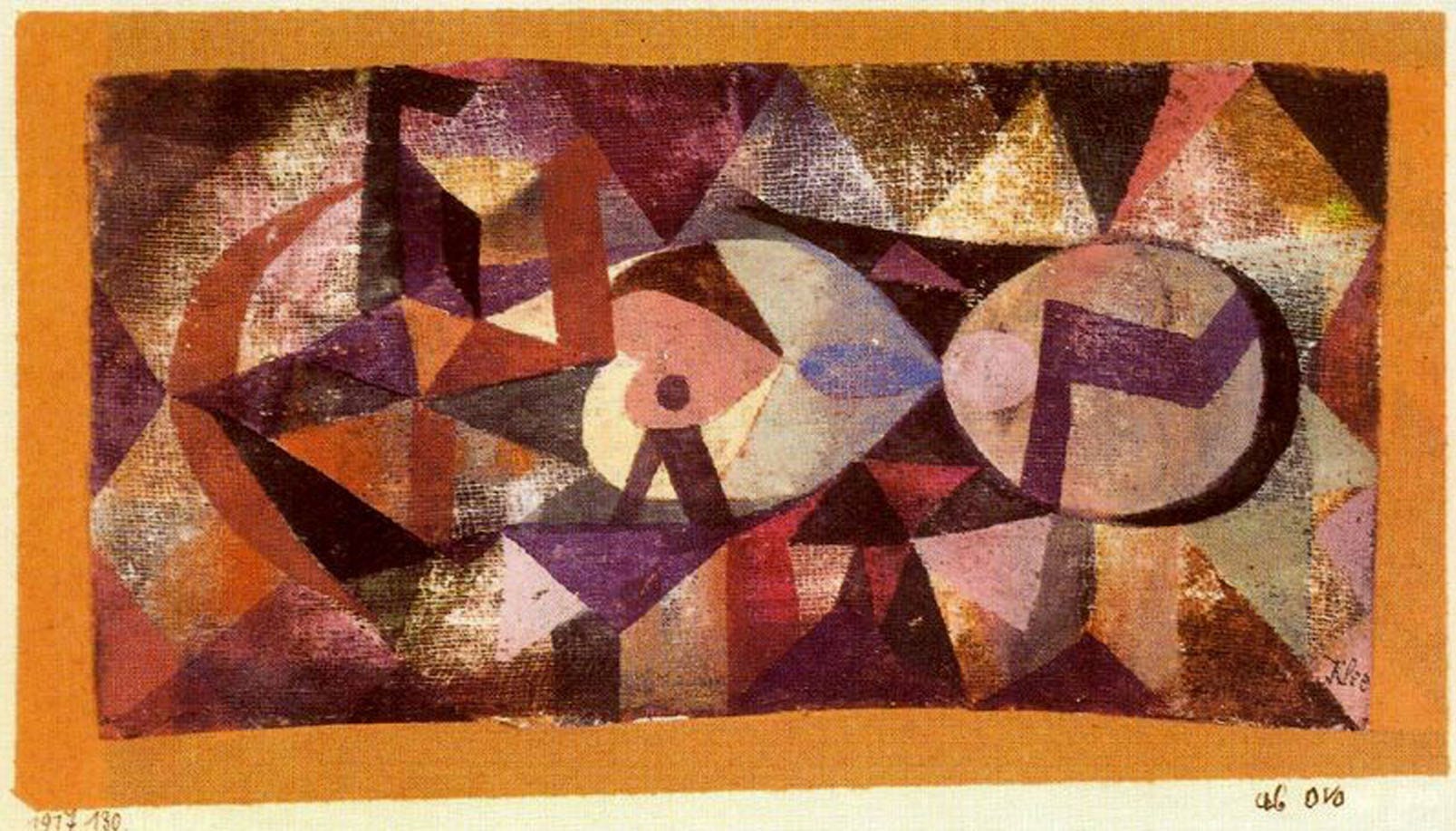
Paul Klee, Ab ovo (1917).
This article is part of a monthly series on the Preface to Hegel’s Phenomenology of Spirit, adapted from my lectures on the topic for the Melbourne School of Continental Philosophy in 2024. Quotations from the Phenomenology are cited by paragraph number, from Michael Inwood’s translation (Oxford University Press, 2018). Each article is written to stand intelligibly on its own.
Hegel’s Preface to the Phenomenology of Spirit begins with a denunciation of prefaces. He declares that although the preface is a customary genre, it is unsuited to the scientific pursuits of philosophy: “The sort of statement that might properly be made about philosophy in a preface [...] cannot be accepted as the way and manner in which to expound philosophical truth” (PhG §1). In its form, the preface is supposed to be a preliminary report on the content of the work, but such a report is not suitable to that content. Philosophy proper seeks to incorporate its particular moments in the universal, to progress from the facts of finite experience to truths not bound by this finitude. In stating the result of the work, the preface fails to exposit this process. Rather, it leaps ahead, to declare truths that have not yet been demonstrated. It is therefore not a philosophical genre but, in Hegel’s works, an anatomical one: it can only present the particularities of its object as part of a finished whole, or as dissections of something which is dead and finished. Even as an overview of what is to come, a preface does a disservice to its material, which, if it is not treated as part of a completed whole, is given as a series of incidental and unexplained details. Naturally, whatever the preface may say about them, these details remain to be worked out in the course of the book itself. In all prefaces, there is a deception at work, because they claim to give a taste of the work and its principal topics, but they are incapable of exposing the substance of the work—which is contained only in the work itself. In a sense, the preface precludes the book, which has been passed over and its conclusions revealed before it has even begun.
If prefaces are ill-suited to the content of philosophical work, this is not the genre’s only problem. Typically, the author of a preface will say something about the context of their work, but this subjects the work to measures external to it. Especially problematic for Hegel are the notions of truth and falsity that the work meets in public opinion, which treats every work as opposed to every other with which it does not conform: “Opinion does not comprehend the diversity of philosophical systems as the progressive unfolding of the truth” (§2). The learned public may read many prefaces to many different books, and from these it will attempt to deduce the sides and factions of a debate, pitting the works against one another. What this discourse does not comprehend is the development of these positions, the common presuppositions upon which they may rest, and the ways they interact with one another apart from the apparent contradictions of their results.
In a nice turn of phrase, Hegel says that this court of opinion would compare the bud and the blossom of a flower and judge them mutually incompatible, and hence impossible to place within the same living body. “The bud disappears when the blossom bursts forth, and one could say that the bud is refuted by the blossom. [...] Yet at the same time their fluid nature makes them moments of the organic unity” (§2). It is possible to read in this metaphor an implicit reference to Goethe’s essay on the Metamorphosis of Plants, which sets out to discover the basic form of plant life that unites the diversity of the kingdom. According to Goethe, this originary form is the leaf, visible in the shape of the smallest saplings, which twists and turns upon itself to gradually transform into stems, branches, buds, and blossoms. Preserved in all of these outgrowths is the Urform of the leaf, from which the organic unity of the plant is derived. By contrast, Hegel does not seek the originary form of things in the same manner as Goethe, though he is concerned with the plasticity of form. His plant-metaphor speaks not to the original sameness of diverse shapes, but to the unfixing of these shapes from themselves as they take on new configurations across time.
To complicate this image, we should note that the metaphor only works diachronically in a sequence of moments. In fact, the blossom does supplant the bud in time, and they cannot be present simultaneously, or at least not in the same place at once. Still, this is only a problem for the abstract point of view that wants to fix things just as they are. This perspective can be contrasted with later sections of the Phenomenology, where we find a philosophy of nature that wants to account for the organic unity of diverse organs in the body and opposed species in the environment. In diachronic terms—distended through time—the growth of the plant appears as a transition from one mutually exclusive shape to another; but synchronically, there is no contradiction of a single plant composed of stems, branches, buds, and blossoms. When we speak of organic unity, we may consider the body as a collection of different elements; organs that differ from one another in form and function, but still cohere in a whole. On another scale, though a cat is not a dog, cats and dogs may both be integral parts of a shared environment. The synchronic perspective that can incorporate these elements in a cohesive whole cannot be presumed and must first pass through these disparate moments without knowing their place in the bigger picture. Hence, some of the difficulty of the Phenomenology is the malleability of the various forms of consciousness, spirit, or thought that are encountered. All are mutable; each will give way as other shapes emerge. At this point in the work, a general principle of mutability may be asserted, but as a principle it is still too abstract: there is no guarantee at the outset that this principle will hold true in the course of the work.
Nevertheless, the abstract consciousness of public opinion desires exactly this kind of guarantee. It wishes to boil the work down to three components: namely, its aim, its result, and its difference from other attempts. These are the typical matters of a preface, but to mistake them for the spirit of the whole work is to avoid what is at stake in its exposition. In the first place, the explanation of the work’s aim cannot be an exhaustive substitute for the work itself, because this intention is only realised in its elaboration. At best, a gesture can be made toward the overall view of the work, though this summary must be less significant than what it summarises. More objectionable is the result set apart from the work. In Hegel’s phrase, the result severed from the process that brought it to fruition must have the appearance of a corpse, lacking even the tendency to develop that is expressed in the aim. While the aim attempts to state the conceptual direction of the work, the result states only what is fixed, finished, or dead:
“The Thing is not exhausted by its aim, but by its elaboration, nor is the result the actual whole, but only the result together with its becoming. The aim by itself is a lifeless universal, while the tendency is a mere drift that as yet lacks its actuality; and the naked result is a corpse which has left the tendency behind” (PhG §3).
In like manner, the work’s difference from other works also tells us little about it. Though we may say what it is not, or at best detail its relation to the works of others, we have not yet said what it is. The writer of a preface may wish to entertain their readers by polemicising their opponents and detailing their intellectual genealogy, but all this is for show and only postpones the proof that is in the body of the work. In this way, the aim, result, and distinction are ways of avoiding the topic at hand and subordinating it to some ready-made judgement. The reader of a preface expects some benefit from it that they can have ahead of (or in the place of) their reading of the work. In his own Preface, Hegel does not avoid these conventions, though he does take them as the first hurdles that a serious work of philosophy must overcome.
Hegel’s intention is not to flout the expectations of a preface but to give them their proper place in the work. The abstractions that make up a typical preface are not to be avoided but must be treated as the starting points from which the philosophical work will eventually depart. This is because abstract thought is not mistaken thought but ordinary or everyday thought; that is, the thought most in need of philosophical instruction. For Hegel, an abstraction is an unelaborated universal, or the result of some prior process of thought that has become accepted as second nature. Hence, the awareness of our abstractions is the first step to putting these thought-objects back in motion as concepts:
“We get acquainted with universal principles and points of view; we work our way up at first only to the thought of the Thing in general; [then] we learn to apprehend the rich and concrete abundance with determinate precision” (PhG §4).
For this reason, even though Hegel may speak against prefaces as general overviews, this generality may well be the starting point of any philosophy, which requires a terrain in which to develop, though this space may be littered with the detritus of past efforts.
If Hegel must state a goal at the outset of the work, it is no less than the realisation of philosophy as a science. By science (Wissenschaft) he means a systematic body of knowledge that would bring unity to the philosophical discourses of epistemology, ethics, metaphysics, and logic, alongside the various branches of philosophy attached to the empirical domains—the philosophies of nature, of history, of civil society, and so on. As a system, philosophy would cease to be a handmaiden to other discourses and would discover its own inner coherence: “The true shape in which truth exists can only be the scientific system of truth [or] its being able to give up the name of love of knowledge and become actual knowledge” (§5). If this is the goal of the work, Hegel would like to show that this is not a whim like the aim discussed above, but is a consequence of two necessities which philosophical thought encounters. Firstly, there is the inner necessity of knowledge as implicitly scientific, having laws that demand a systematic exposition. That is, the wager of the work is that a system is not something imposed upon a body of knowledge but something which already structures it, though we may not yet have recognised it. Second is an external necessity, that it is time for this implicit science of philosophy to be realised. Hegel will elaborate on this at the end of the Preface, where he argues that it is not up to the philosopher to craft a system, like some genius pulling his work from the aether. Rather, the writer of philosophy registers the thought of their time, which has developed collectively across centuries so that it may be distilled in this individual work.
The success of the work depends on its timeliness and the extent to which it comprehends the structures of thought within which it exists. But if this is the task of the work itself, the role of the Preface is more untimely: it runs ahead of the work, and hence ahead of the thought it is supposed to register. This is something that Heidegger notes in his reading of the Phenomenology. He argues that because Hegel must show the absolute at work in the relative, he has to present this universal perspective through a series of incompatible moments. The Preface, then, lets us prejudge this absolute, which is present at the outset as a conclusion already ‘not yet’ known (Heidegger, Hegel’s Phenomenology of Spirit, p. 32-3). Hence, according to this reading, the work becomes tautologically caught between what it has not yet demonstrated and what it prejudges as already evident. However, this criticism must itself make use of the abstract notions of aim and result that Hegel rejects as too fixed to describe the intentions of the work itself. In fact, when Hegel does get to the topic of the absolute, he is at pains to note that the absolute described in the a preface must be defined abstractly, and cannot be identical to the absolute knowing found at the end of the book. Bringing the untimeliness of the Preface back to the time of the work, Hegel notes that the notion of the absolute given in the Preface is another abstraction that must be worked through and exposited in a conceptual light.
By contrast with Heidegger’s reading, though owing something to it, is Derrida’s commentary on the Preface. Rather than take the Preface as a tautological folding of the work upon itself, Derrida sees it as a site of division within the work. That is, the Preface is divided between two locations: it is both inside and outside the concept; or, it is on the one hand an abstract statement, and on the other it presents a model for the system. The Preface is therefore caught between two positions or two modes of exposition: the logical-systematic and the formal-abstract. The intention of the work may be to leave behind the formalism of the latter discourse, but it also needs to show the necessity of the concept within that discourse. Though the desire of the Preface may be for the logical-systematic perspective, it can only be got at (at this stage, at least) by means of formal-abstract discourse. Hence, the Preface must have a critical function of presenting the formalist views of philosophy so they may be sheared away to clear a path for the work itself. In Derrida’s lovely turn of phrase (Disseminations, p. 14), the opening section of the Phenomenology is less a preface than an endless ‘postface’ which inaugurates a philosophy that ‘will have been fulfilled,’ but not here, not now! In these opening pages, everything remains to be seen, though Hegel wastes no time in disabusing us of the presumptions of genre, of form, of structure, that may prevent us from recognising the true thought of our time.